Identifying Critical Safety Risks at Data Centers
Published on November 18, 2026 by Staff Writer | Edited by Joey Rosenberg
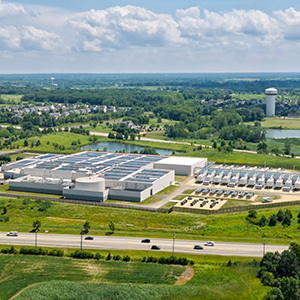
Digital infrastructure is expanding faster than ever, and with it comes a set of operational realities that facility teams can't afford to overlook.
To help operators and site personnel build a crucial baseline of awareness, the team at Certus set out to identify the specific safety risks tied to data center operations.
Behind every "always on" server room are everyday physical hazards that rarely make headlines but can carry real consequences.
We’ll break down five categories of risk — electrical, thermal, mechanical, acoustic and fire — that every data center worker should be able to recognize and protect against.
Key Takeaways
- Arc flashes can exceed 35,000°F — nearly four times hotter than the surface of the sun.
- Every watt of power used by IT equipment produces approximately one watt of heat, making temperature monitoring and airflow management critical.
- Some fully configured high-density AI servers weigh more than 250 pounds, increasing the risk of back and shoulder injuries during installation and maintenance.
- NIOSH recommends limiting exposure to 85 dBA to eight hours and cutting the exposure time in half for every 3 dBA increase.
- Lithium-ion UPS battery fires can spread through thermal runaway, making early detection, power disconnection, cooling and containment essential.
Mitigating Major Data Center Threats
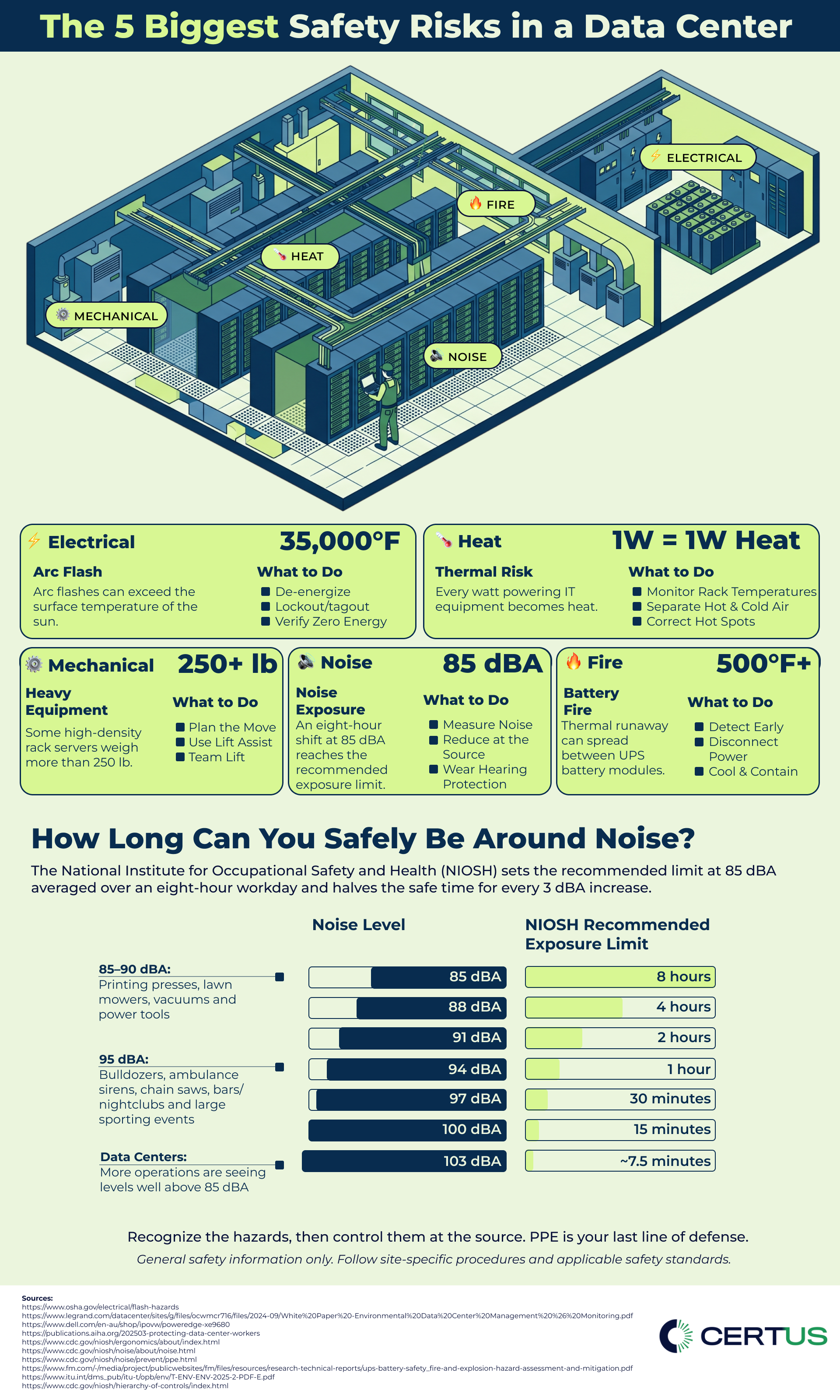
Severe physical hazards can exist even in the most tightly controlled environments, like data centers. From high-voltage electrical panels to high-density server racks, understanding these risks is the first step toward incident prevention and workforce competency.
1. Arc Flashes and Other Electrical Hazards
Keeping servers running around the clock takes an enormous amount of power. The switchgear, transformers and distribution equipment that deliver it can expose workers to electric shock, electrocution and severe burns.
Arc flashes are among the most dangerous of these hazards. An arc flash is a type of electrical explosion that occurs when current leaves its intended path and travels through the air. It can reach temperatures above 35,000 degrees Fahrenheit, nearly four times hotter than the surface of the sun.
Workers don’t have to touch energized equipment to be hurt, and lower voltage doesn’t mean lower risk. According to OSHA, even standard 120/208-volt systems can produce arcs strong enough to burn exposed skin and ignite clothing. That’s because arc energy depends largely on the available current, not the voltage.
Before any electrical work begins, personnel must:
- De-energize the equipment.
- Apply lockout/tagout (LOTO) procedures.
- Verify zero energy before starting work.
2. Heat and Thermal Stress
Every watt of power that flows into a data center has to go somewhere, and nearly all of it ends up as heat. In IT operations, the rule of thumb is simple: one watt of power consumed produces one watt of heat.
Cooling systems are designed to continuously remove that heat. When they fall behind, hot spots form around the racks, and equipment can quickly exceed its safe operating limits.
The heat affects people as well as hardware. Technicians often work in hot aisles, where server exhaust collects, and extended time in those spaces can expose them to heat stress. That, in turn, makes it harder to stay focused around energized equipment.
Effective heat management requires teams to:
- Monitor rack temperatures, keeping server inlet air within the recommended 65 to 80 F range.
- Separate hot and cold airflow.
- Identify and correct hot spots quickly.
3. Heavy Equipment and Injury Risk
Data centers are packing more and more computing power into every rack, and the hardware is getting heavier as a result. Some high-density AI servers weigh more than 250 pounds when fully configured.
Maneuvering that much weight through narrow aisles and lifting it into rack positions puts technicians at real risk of musculoskeletal injuries, particularly to the back and shoulders. To ensure safety, the National Institute for Occupational Safety and Health (NIOSH) recommends designing the task around what workers can safely handle, rather than expecting workers to adapt to the load.
In practice, that means teams must:
- Plan the move by assessing the load and the travel route before lifting.
- Use mechanical lift assists.
- Use multiple people to lift heavy units.
4. Noise Exposure Limitations
Cooling units and servers running at full tilt create another persistent hazard: noise. Environmental noise levels in data centers can exceed 85 dBA, and the American Industrial Hygiene Association (AIHA) notes that more and more operations are seeing levels well above that.
That 85 dBA mark matters. NIOSH sets its recommended exposure limit at 85 dBA averaged over an eight-hour workday, and workers regularly exposed at or above that level are at risk of significant hearing loss over their working lives.
How Long Can You Safely Be Around Noise?
A few extra decibels make a big difference. For every 3 dBA increase in noise, NIOSH recommends cutting exposure time in half.
Noise Level | NIOSH Recommended Exposure Limit |
85 dBA | 8 hours |
88 dBA | 4 hours |
91 dBA | 2 hours |
94 dBA | 1 hour |
97 dBA | 30 minutes |
100 dBA | 15 minutes |
103 dBA | ~7.5 minutes |
For perspective, lawn mowers and power tools produce noise in the 85–90 dBA range. Exposures that average 95 dBA or higher include ambulance sirens, chain saws and nightclubs.
To control noise hazards, facilities must:
- Measure noise levels throughout the facility.
- Reduce noise at the source.
- Limit how long workers spend in high-noise areas.
- Require hearing protection where levels exceed recommended limits.
5. Fire Risks in Battery Backup Systems
Data center fires can start in overheated equipment or damaged wiring. The battery systems that keep a facility running through a power outage carry a distinct risk of their own. Many uninterruptible power supply (UPS) systems now use lithium-ion batteries, which can act as both the ignition source and the fuel in a fire.
The biggest danger is thermal runaway, a self-sustaining reaction in which a failing battery cell overheats uncontrollably and can trigger the same failure in surrounding cells.
In a 2026 full-scale fire test of a lithium-ion UPS system, thermal runaway spread from one battery module to others in the same cabinet. It spread even though the room’s sprinklers had activated, because the enclosure kept water from reaching the batteries. Modules in neighboring cabinets heated to above 500 F, at which point their cells began venting flammable gas.
That same system had already passed a standard industry certification test. It took an entire redesign to keep the fire confined to a single module in future tests.
Stopping the spread of battery fires involves three critical steps:
- Detect the fire early.
- Disconnect power to the affected system.
- Cool and contain the affected modules.
Recognize the Risk to Control the Hazard
These five hazards are connected. The electrical power that runs the servers creates the heat, the cooling that removes the heat creates the noise and the batteries that protect against outages bring their own fire risk. Facility managers are responsible for training personnel to recognize each one and react accordingly:
Hazard Category | Mitigation Action |
Electrical | De-energize |
Thermal | Monitor |
Mechanical | Assess |
Acoustic | Measure |
Fire | Contain |
It’s also critical to have the right personal protective equipment (PPE) on hand and make sure that all data center staff are trained to use it properly.
The right equipment depends on the hazard, from arc-rated clothing and insulated gloves for electrical work to hearing protection for high-noise areas. Every worker should be trained to select and use it properly.
But PPE should always be the last line of defense, not the first. Protecting data center workers starts with a shared baseline of safety awareness for every operator, contractor and vendor on site before anyone touches a rack or panel. That’s the gap our Data Center Safety Awareness Certificate is built to close. Developed with environmental, health and safety (EHS) leaders from data centers worldwide, the course gives every worker entering a facility a common language for identifying and controlling these five hazards.
Explore Certus enterprise training solutions to build a safety program suited to your site.
About Certus: Certus provides workforce training and certification solutions for organizations across regulated industries. Its programs include enterprise technical and workplace safety training, as well as the Data Center Safety Awareness Certificate developed in partnership with the Data Center Safety Council.
Sources:
U.S. Occupational Safety and Health Administration. (n.d.). Electric-Arc Flash Hazards. Retrieved from https://www.osha.gov/electrical/flash-hazards
Legrand. (2024). Environmental Data Center Management and Monitoring. Retrieved from https://www.legrand.com/datacenter/sites/g/files/ocwmcr716/files/2024-09/White%20Paper%20-Environmental%20Data%20Center%20Management%20%26%20Monitoring.pdf
Dell Technologies. (n.d.). PowerEdge XE9680. Retrieved from https://www.dell.com/en-au/shop/ipovw/poweredge-xe9680
The Synergist. (2025, March). Protecting Data Center Workers. Retrieved from https://publications.aiha.org/202503-protecting-data-center-workers
National Institute for Occupational Safety and Health. (2024, February 21). About Ergonomics and Work-Related Musculoskeletal Disorders. Retrieved from https://www.cdc.gov/niosh/ergonomics/about/index.html
National Institute for Occupational Safety and Health. (2024, January 30). Noise-Induced Hearing Loss. Retrieved from https://www.cdc.gov/niosh/noise/about/noise.html
National Institute for Occupational Safety and Health. (2024, January 31). Provide Hearing Protection. Retrieved from https://www.cdc.gov/niosh/noise/prevent/ppe.html
FM. (2026, April). UPS Battery Safety: Fire and Explosion Hazard Assessment and Mitigation. Retrieved from https://www.fm.com/-/media/project/publicwebsites/fm/files/resources/research-technical-reports/ups-battery-safety_fire-and-explosion-hazard-assessment-and-mitigation.pdf
International Telecommunication Union. (2025, May). White Paper on the Safety of Lithium-Ion Battery Applications in Data Centres. Retrieved from https://www.itu.int/dms_pub/itu-t/opb/env/T-ENV-ENV-2025-2-PDF-E.pdf
National Institute for Occupational Safety and Health. (2024, April 10). Hierarchy of Controls. Retrieved from https://www.cdc.gov/niosh/hierarchy-of-controls/about/index.html